
 6 min read
.jpg?width=400&name=Visuel%20ISO9001%20(1).jpg)
Last updated on 04/27/2026
Since 1987, the ISO 9001 standard has remained the global benchmark for quality management. It has been adopted across all sectors, from manufacturing and healthcare to public services and technology. According to data from the ISO Survey, it is the most widely used quality management standard in the world, with over 1.1 million certificates issued to organizations in 178 countries. Given this international reach, the update scheduled for 2026 is naturally drawing significant attention,—including in Quebec, where many organizations rely on ISO 9001 to structure their performance, compliance, and organizational culture.
With the rapid evolution of environmental, digital, social, and regulatory challenges, an update was necessary. Consequently, after more than a decade of stability since the 2015 version, the new ISO 9001:2026 edition is now being finalized.
This article provides a complete, practical, and contextualized breakdown for the Quebec market to help you anticipate your transition.
Key dates: What organizations need to know
The official revision process follows a clear timeline:
- August 27, 2025: Publication of the Draft International Standard (DIS), the formal draft of the standard.
- Early 2026, ISO: Expected publication of the Final Draft International Standard (FDIS), the final version before approval.
- September 2026: Official publication of the ISO 9001:2026 standard.
- 2026–2029: A three-year transition period to adapt management systems.
|
Term |
Meaning |
Period |
|
ISO/DIS 9001 |
Draft International Standard – Draft standard |
Current (International inquiry phase) |
|
ISO/FDIS 9001 |
Final Draft International Standard |
Early 2026 (if required) |
|
ISO 9001:2026 |
Final published standard |
Scheduled for september 2026 |
For Canadian businesses, this means it is already time to plan ahead to avoid a rushed transition, especially in the context of the current labour shortage, where the capacity to lead internal projects is often under strain.
Continuity over revolution: A revision focused on reinforcement
All sources agree: the 2026 version will not disrupt the current architecture, which remains based on Chapters 4 to 10 and the HLS(High-Level Structure).
The ISO committee’s goal is not to force organizations to reinvent their quality management system (QMS), but rather to modernize, strengthen, and align it with emerging challenges. In short, it is an evolution that maintains stability while integrating current realities.
Major updates in ISO 9001:2026
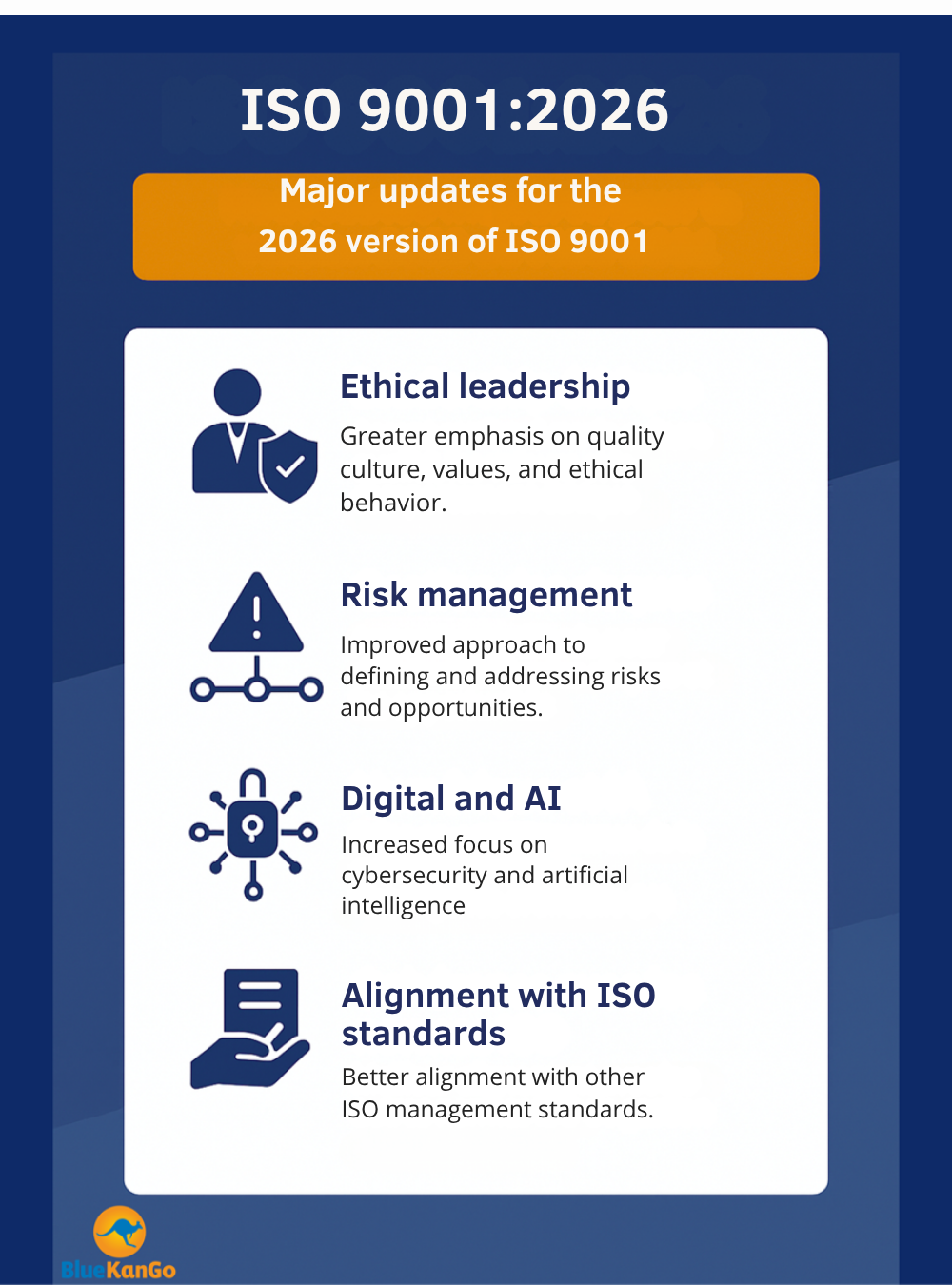
Leadership: A stronger focus on ethics and quality culture
The 2026 version requires leadership to actively embody quality values and integrity through their decisions, communications, and behaviours.
For organizations, this impacts:
- governance;
- expected management behaviours;
- transparency in internal communications;
- prevention of unethical conduct.
This shift aligns with what many joint health and safety associations in Quebec already promote, particularly regarding a healthy organizational culture.
Risk and opportunity management: A more robust structure
Chapter 6.1 has been revised to:
- better identify risks and opportunities;
- integrate emerging challenges (climate, cybersecurity, reputation);
- encourage proactive logic.
This evolution aligns perfectly with the reality of Canadian businesses, which must deal with increasing digitalisation, climate risks directly impacting supply chains, and rising expectations from financial partners and contracting parties.
Digital technology, data, and Artificial Intelligence (AI): An essential shift
Several sources highlight that the 2026 version accounts for the growing impact of AI, cybersecurity, and data management. Requirement 8.5.3, regarding the protection of customer property, now explicitly emphasizes the importance of personal data and intellectual property. With the rapid adoption of AI within organizations, often without a formal framework, this point becomes crucial.
This means organizations must pay close attention to several key elements: establishing frameworks for AI use through internal charters or policies, maintaining rigorous and structured document control, increasing access control for systems and data, and providing continuous staff awareness training to ensure a uniform understanding of best practices regarding security and compliance.
Stakeholder Relations and Consistency with Other ISO Standards
The 2026 revision seeks to further harmonize ISO 9001 with other standards (notably ISO 14001 and ISO 45001).
This addresses the needs of:
- multi-site organizations;
- companies with QHSE (Quality, Health, Safety, and Environment) certifications;
- operational teams seeking more consistent and less redundant frameworks.

Infographic
ISO 9001:2026 - Major updates for the 2026 version of ISO 9001
Download our infographic for free.
You confirm that you accept the processing of your personal data by BluKanGo, in accordance with the Privacy Policy (GDPR), and that you agree to receive our communications. You may unsubscribe at any time.
What this means for organizations
SMEs must plan ahead to avoid a rushed transition
In Quebec, the ISO 9001 standard is particularly widespread among SMEs, in both the manufacturing and service sectors, two environments where organizations seek to structure their processes and demonstrate compliance. While a three-year window may seem long, in practice, it moves very quickly.
Integrating digital challenges into the QMS
Integrating digital challenges is becoming unavoidable, especially as cybersecurity, data protection, and privacy are now recognized as essential dimensions of operational resilience. ISO itself notes that IT security, cybersecurity, and privacy protection are now vital for businesses, as they are constantly exposed to cyber threats that can compromise sensitive information and intellectual property.
From this perspective, Canadian organizations must increase their focus on data governance, specifically regarding:
- the robustness of their security policies;
- control over hosting environments (including the management of servers located outside of Canada);
- compliance with personal data protection requirements;
- prevention of accidental leaks related to the use of digital tools or AI.
These concerns align directly with the international directions put forward by ISO, which insists that the value of information is inseparable from the need to ensure its security, confidentiality, and availability. In the digital age, this challenge is structural, and the transition to ISO 9001:2026 offers a strategic opportunity to integrate these practices systemically.
Maturing in ethics and quality culture
Companies will need to demonstrate more visible leadership, ensure tangible consistency between their values and daily practices, and adopt a more structured and rigorous approach to professional integrity to meet the heightened expectations of the standard and its stakeholders.
How digital solutions support the transition to ISO 9001:2026
The ISO 9001:2026 revision places greater emphasis on risk management, quality culture, ethics, business continuity, and the integration of digital challenges. In this context, digital solutions play a vital role in supporting organizations in their compliance and continuous improvement efforts.
Here is how modern digital tools can facilitate the transition:
- Increased traceability and data consolidation: Digital platforms centralize information, track actions in real-time, and automatically document evidence of compliance.
- Dynamic risk and opportunity management: With the split of Chapter 6.1 into "risks" and "opportunities," organizations must perform more structured and up-to-date analyses. Digital solutions facilitate identification, assessment, planning, and follow-up on measures.
- Support for quality culture and ethics: The new version requires management to tangibly demonstrate a quality culture and ethical behaviour. Digital tools help distribute policies, reinforce awareness, document training, and standardize practices across multiple sites.
- Better management of hybrid environments and remote work: The explicit inclusion of hybrid work in infrastructure (7.1.3) requires reliable mechanisms for communication, information sharing, and remote collaboration. Digital solutions provide uniform access to documents, version control, and fluid coordination between teams.
- Simplified audit preparation: Digital tools simplify the preparation and execution of internal or external audits through the use of dashboards, automated histories, accessible evidence, and processes already structured according to the standard.
- Natural integration of digital challenges and AI: As the 2026standard now incorporates challenges related to emerging technologies, organizations equipped with digital solutions have a head start in framing AI use, protecting data, and demonstrating control over their processes.
The ISO 9001:2026 standard represents continuity while modernizing quality management to reflect deep market transformations, digitalisation, and societal expectations. For Quebec organizations, this revision is a strategic opportunity to strengthen quality, structure responsible innovation, and improve overall performance.

. . .