



Last updated on 07/01/2026
In a climate shaped by economic uncertainty, trade tensions between Canada and the United States, rapidly shifting supply chains, and the rise of cyber threats, Canadian organizations must strengthen their resilience. The Business Continuity Plan (BCP) has become a cornerstone for safeguarding operational stability, worker safety, and service continuity, in both the public and private sectors.
What is a BCP?
A Business Continuity Plan (BCP) is a structured set of measures designed to maintain or quickly restore an organization's critical activities following a disruptive incident.
It typically addresses:
- technology disruptions (outages, cyberattacks)
- physical disasters (fires, floods, storms)
- workforce crises (mass absenteeism, labour shortages)
- geopolitical or economic factors
- disruptions affecting key suppliers or partners
In Canada, a BCP should be guided by ISO 22301 standard, the internationally recognized standard for business continuity management.
Why should Canadian organizations be concerned about it in 2026?
Economic pressure between Canada and the U.S.
The current commercial relationship between the two countries is creating instability across Canadian supply chains:
- fluctuating tariffs
- unpredictable logistics timelines
- growing dependence on certain American suppliers
These factors introduce a systemic risk that only a well-structured BCP can mitigate.
The rise in cyber incidents
According to trends reported by the Canadian Centre for Cyber Security, attacks targeting small and medium-sized enterprises (SMEs) and public sector organizations continue to climb.
A BCP should include:
- an IT Disaster Recovery Plan (DRP)
- reinforced cybersecurity measures
- data protection and IT continuity strategies
A legal and regulatory framework to uphold
While Quebec legislation does not formally require a BCP, several related obligations make one effectively necessary, including:
- CNESST: the duty to protect worker health and safety, including in emergencies.
- The Modernized Act respecting Occupational Health and Safety: strengthens prevention mechanisms in Quebec workplaces.
- Municipal, provincial, and sector-specific standards (essential services, healthcare institutions, critical infrastructure).
The post-pandemic landscape: shortages, absenteeism, and workplace transformation
The public health emergency may be behind us, but several of its consequences remain:
- persistent labour shortages
- hybrid work models that require tailored emergency protocols
- a heightened need to manage psychosocial hazards
The essential steps for building an effective BCP
Carry out a risk andimpactanalysis (BIA - Business Impact Analysis)
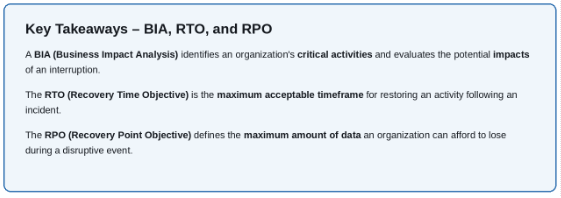
This first step involves identifying critical activities, evaluating the consequences of disruption, and defining tolerance thresholds such as Recovery Time Objective (RTO) and Recovery Point Objective (RPO). It clarifies what absolutely must be maintained to prevent operational paralysis.
Identify the resources required for continuity
Catalogue every resource needed to keep critical activities running: people, suppliers, infrastructure, technology, data, and key partners.
Develop continuity strategies
Define the solutions that will support continued operations or recovery, including IT redundancy, alternate work sites, emergency remote work arrangements, supplier diversification, and structured internal and external communication protocols.
Build operational plans
Formalize response guides covering the organizational BCP, the crisis management plan and crisis response team, the IT Disaster Recovery Plan, and the OHS emergency response plan.
Test, refine, and document
Simulations are essential for validating a BCP's effectiveness. Organizations should exercise and update their plan at least once a year to drive continuous improvement.

Infographic
Business continuity plan (BCP)
Download our infographic for free.
You confirm that you accept the processing of your personal data by BluKanGo, in accordance with the Privacy Policy (GDPR), and that you agree to receive our communications. You may unsubscribe at any time.
Common mistakes to avoid
One of the most widespread mistakes is failing to engage senior leadership from the start. Without clear commitment and strong governance, a BCP remains a theoretical document with little chance of being applied effectively when a crisis hits. Executive support is essential for prioritizing resources, validating critical activities, and fostering a genuine culture of resilience.
Another frequent pitfall is depending on a single critical supplier, particularly in the current Canada–U.S. context, where supply chains are highly sensitive to economic and logistical shifts. This kind of dependency leaves organizations exposed to any disruption upstream. A sound continuity strategy should incorporate supplier diversification or fallback options to reduce that exposure.
Many organizations also fail to test their BCP, which significantly limits its real-world value. An untested plan can mask inconsistencies, unclear roles, and unrealistic recovery timelines. Drills, simulations, and regular updates strengthen response capacity and confirm that continuity strategies actually work.
One of the most critical oversights is neglecting cybersecurity. With cyber incidents, particularly ransomware, now ranking among the leading causes of operational disruption in Canada, a BCP must include a robust IT recovery plan and advanced cybersecurity safeguards.
Finally, some organizations overlook regional realities, which is a serious gap in a country as vast as Canada. Risks, available infrastructure, climate conditions, and regulatory requirements vary across provinces and territories. To be genuinely effective, a BCP must be tailored to its territory and reflect local specifics. and reflect local specifics.
In a business environment defined by economic uncertainty, Canada–U.S. trade tensions, growing reliance on technology, and the rising frequency of cyber threats, business continuity is no longer optional, it is a strategic imperative.
A solid, documented, and tested BCP gives Quebec and Canadian organizations the ability to maintain essential operations, protect their workforce, meet their legal obligations, and preserve credibility with partners and clients. Whether you run an SME, a public agency, or a large multi-site organization, a BCP serves as both a safety net and a driver of long-term performance. Organizations that invest in resilience operate with greater agility, anticipate crises more effectively, and strengthen their long-term competitiveness.


. . .